
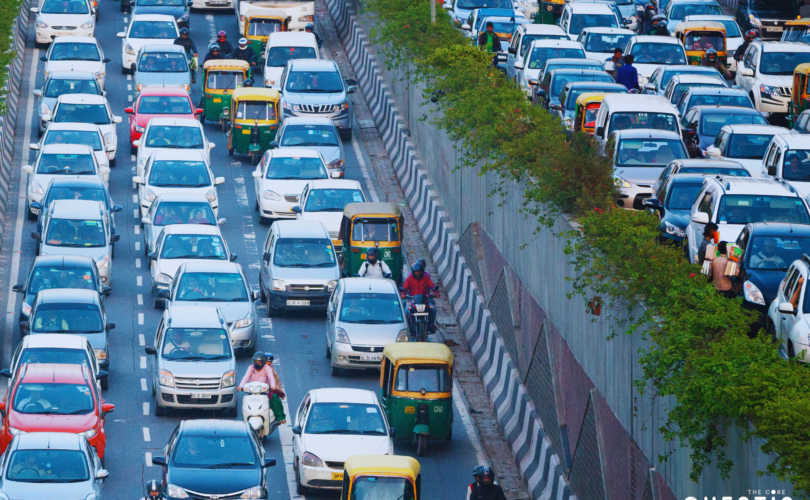
I am a relatively new driver. An anxious one at that. Which means every time I get behind the wheel, my nervous system is already doing more work than it probably needs to. It also helps very little that I drive in Delhi.
And yet, every day, I pull up to a traffic light and place an extraordinary amount of trust in complete strangers (fingers and toes crossed).
I trust that the driver coming from the opposite direction will stop when the light turns red. I trust that the pedestrian will wait. I trust that the car behind me won’t suddenly decide that traffic rules are merely suggestions.
It’s a remarkable act of faith. I know almost nothing about the people around me. And yet, I proceed. Because I trust the system, more than the individuals.
The lights, the rules and the predictability of how things are meant to work create enough confidence for millions of strangers to move through intersections every day. When the traffic lights stop working, our confidence changes almost immediately. What changes? Not the people, but the system.
What if we were to view organisational trust under a similar lens.
Consider two organisations. Both have capable and well-intentioned leaders. Yet in one, information arrives unevenly, important decisions are made behind closed doors and people learn that speaking up comes at a cost. In the other, information is shared consistently, decision-making processes are visible and dissent is welcomed.
Which organisation is more likely to be trusted?
We often talk about trust as though it were an individual or interpersonal trait alone: something built through authenticity, vulnerability and good intentions. But what if people trust organisations more because of how their systems behave over its people?
In fact what if trust is a value that can be part of the systems architecture itself.
By architecture, I don’t mean office design. I mean the invisible systems that govern organisational life: who has access to information, how decisions are made, what behaviours are rewarded and what happens when someone takes an interpersonal risk. Structures that shape people’s expectations of fairness, safety and predictability, the very conditions from which trust emerges.
Research supports this view. The work of psychologist Tom Tyler shows that trust in institutions depends less on whether outcomes favour us and more on whether the processes that produce those outcomes are perceived to be fair and transparent. Similarly, Amy Edmondson has shown that people speak up not because they are encouraged to, but because repeated experiences have convinced them that candour is safe. Again, systems.
Trust, then, is often a rational response to the systems people inhabit.
Employees are constantly observing:
- How is bad news received?
- Who gets access to information?
- What happens when someone makes a mistake?
- Is disagreement genuinely welcomed or merely tolerated?
The answers to these questions become an organisation’s trust architecture. They particularly live in:
- Information: Few things erode trust faster than information asymmetry. In the absence of information, people create narratives. Transparency, therefore, is a key trust strategy.
- Decision making: People can often live with decisions they dislike. What they struggle with is opacity. Trust depends less on the outcome and more on understanding how and why a decision was made.
- Relational architecture. How dissent is handled, whose voices are heard and what happens when people make mistakes determine whether trust becomes a lived reality or a corporate aspiration.
- Incentive architecture. Employees quickly learn which system to trust: the one written in the values statement or the one reflected in everyday rewards and consequences.
Trust in organisations is always WIP, the architecture comes together bit by bit. Perhaps a good starting point is not “How do we get people to trust us?” but “What is it about the way this organisation is designed that makes trust easy or difficult to sustain?” Because if trust is indeed a system’s outcome,amongst other things, then the work of leadership becomes also an act of design. The design of information flows. The design of decision-making. The design of incentives and conversations. The design of everyday experiences that answer a fundamental question for people: Is it safe to trust this place?
As an anxious new driver, I still don’t entirely trust Delhi traffic. But I trust a functioning traffic light because it creates predictability. Organisations are no different. People trust the system because it behaves in ways that feel fair, safe and predictable, even if people sometimes don’t.
We’ve been sitting with this idea quite a bit lately, particularly the question of what systems are teaching people about fairness, safety and predictability, and eventually about building trust.
If you’re wrestling with similar questions in your organisation, we’d love to compare notes.


