As facilitators, we rarely witness this moment. It’s the three weeks later moment, when one of the participants is sitting in a difficult performance conversation. Or walking into a board review. Or deciding whether to ask one more question instead of rushing to an answer.
Those are the moments that determine whether the work has actually stayed with them.
In our space, one tends to design programmes around the belief that behavioural change takes time, and undoubtedly so. Wherever possible, we build journeys that unfold over months, creating opportunities to reflect, experiment and return with new experiences.
Recently, we’ve found ourselves asking an additional question.
Even when learning is sustained, what helps a leader remember the right idea at precisely the moment they need it?
Looking for answers took us somewhere unexpected.
One of the earliest clues came from psychologist Hermann Ebbinghaus. His work on the Forgetting Curve showed that, without reinforcement, much of what we learn fades surprisingly quickly. More recent research on retrieval practice by cognitive scientists Henry Roediger and Jeffrey Karpicke suggests that memory becomes more durable not by repeatedly seeing an idea, but by repeatedly recalling it.
This becomes even more important in the fast-paced, constantly changing environments leaders operate in today. Under pressure, we rarely stop to remember a framework or revisit our notes. The brain defaults to familiar responses because they require the least cognitive effort.
So perhaps the challenge is helping leaders interrupt familiar patterns long enough to choose a different response.
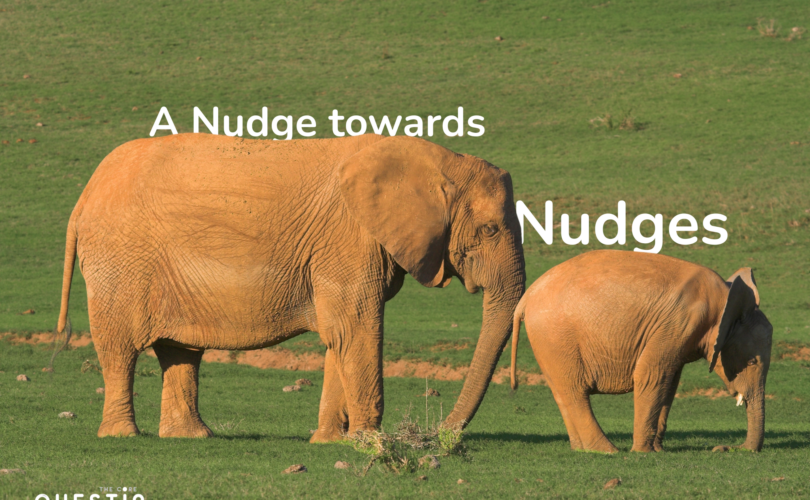
This is where Richard Thaler and Cass Sunstein’s work on Nudge Theory becomes particularly compelling. Rather than asking how we persuade people to change, they ask a different question:
How might we make the desired behaviour easier to choose?
Their research demonstrated that seemingly small changes to our environment can have a disproportionate impact on behaviour. Something as simple as placing healthier food at eye level in a cafeteria significantly increased the likelihood that people would choose it because the desired behaviour had become easier in that moment.
That shifts the question:
What if lesadership development experiences also account for making better leadership behaviours easier to reach for?
Across behavioural science, a remarkably consistent picture emerges. New behaviours are more likely to endure when the environment around them is designed to be:
- Timely – arriving just before a decision or conversation, when behaviour is about to unfold.
- Manageable – small enough to act on, even on the busiest day.
- Retrievable – bringing ideas back over time instead of assuming they’ll be remembered.
- Contextual – woven into the flow of work, rather than sitting outside it.
- Reflective – inviting awareness through thoughtful questions instead of more instruction.
Basically nudges and microlearning at arrives as part of your workflow itself.
None of this diminishes the value of immersive leadership programmes. If anything, it reinforces them. It simply suggests that what happens between workshops may be just as important as what happens within them.
That has led us to rethink where a leadership programme really begins and ends. Perhaps the environment leaders return to every day is just as much a part of the programme as the workshop itself.
This is one of the experiments we’ve begun exploring. Alongside the leadership journeys we design, we’re testing how thoughtfully timed reflections, behavioural cues and moments of recall can help leaders reconnect with ideas they’ve already encountered, by making existing insights easier to access in the flow of work.
We’ll share more about what we’re learning soon.
In the meantime, if you’re designing leadership journeys for your teams and are curious about how behavioural science can strengthen lasting change, we’d love to continue the conversation. Write to us to explore how these ideas can be thoughtfully woven into a programme designed for your leaders.