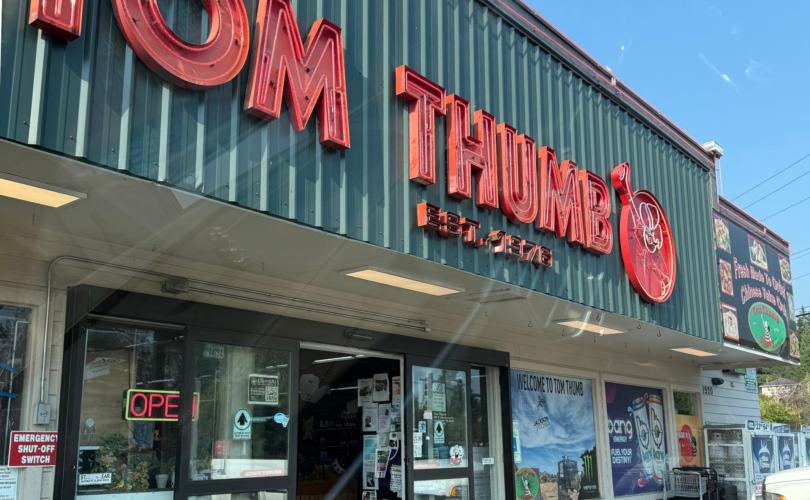
This was my first trip to the US, and it happened on day one. In the Washington town I was visiting, this gas station store called Tom Thumb does a great to-go breakfast buffet alongside the usual knick-knacks. Having forgotten my toothbrush, I stopped in to grab one, and my churning stomach clued me in that breakfast was also in order. The store was run by a single gentleman. I paid him for the toothbrush and asked if he could get me six bagels and hashbrowns to go. He said I could pay for those here too. I waited for him to walk me to the food counter, until he pointed toward a paper bag at the far end of the store, next to the food counter, out of his line of sight, and said I could help myself and call him if I needed anything.
I packed my own food and left. For the rest of the trip, Tom Thumb was a regular stop. And in all my trips I noticed that the same trust was doled out to all customers. And despite many new age stores, most residents of Lake Stevens, end up at Tom Thumb for their needs.
That small act of trust is rarer than it should be. It got me thinking about what it actually meant.
Why one bagel run isn’t a small thing
That gentleman had a choice, and took the harder one. The easier, “efficient” option was to walk me over himself, hand me each item, keep the transaction in view, control disguised as service. Instead, he handed over control and trusted I’d act in good faith. It cost him almost nothing either way. But it told me, instantly, this was a place run by someone who assumed the best of a stranger rather than the worst.
These small actions of trust were peppered across my trip, and really took me back to the work we do around trust and trust building, and how that’s something that always lands.
Organizations face a version of the same choice, at higher stakes and on repeat. A clerk trusting a stranger he’ll likely never see again is low-risk. A manager extending that instinct to a colleague they’ll work with for years, money and outcomes on the line, is harder to sustain. That’s why most default to control instead: does a manager let an expense report through without triple-checking it, or does a leader share the real numbers in a downturn instead of a softened version? Each is a small Tom Thumb moment, except the stakes compound every time it repeats. Most companies flinch. The ones that don’t, they perform measurably better.
What research actually says
Paul Zak, a neuroeconomist at Claremont Graduate University, spent over a decade measuring people’s brain chemistry, specifically oxytocin, the neurochemical linked to trust as well, while they worked, tracking how it correlated with performance. His findings, published in Harvard Business Review, are stark: compared to people at low-trust companies, employees at high-trust companies report 106% more energy at work, 50% higher productivity, 76% more engagement, 74% less stress, and 40% less burnout. This is the chemistry behind why people show up differently when trusted rather than monitored, the same chemistry a clerk in Washington triggered without naming it.
The company that has no managers
The Morning Star Company, the world’s largest tomato processor, built its structure around that chemistry instead of managing around it: no managers, no titles, no top-down directives, across a workforce that swells past 2,000 in peak season. Every employee writes their own “Colleague Letter of Understanding”: a personal mission negotiated directly with the colleagues their work affects, laying out what they’ll deliver and what they need in return. Want new equipment? You don’t ask a boss: you talk to the people it affects, and if they’re convinced, you buy it.
It sounds like it shouldn’t work right? It’s worked for five decades, grown into a nearly billion-dollar company, and become one of the most studied examples of trust-based structure anywhere: Harvard Business School wrote a case on it. It’s also an extreme, rare case, cited precisely because so few companies go this far. But it’s Paul Zak’s data taken to its structural limit: if trust reliably improves individual output, the real unlock might be building the whole system around it, not layering it on top of hierarchy as an afterthought.
What actually builds trust, in the day to day
You don’t need to remove management to borrow the idea, we are all not Morning Star. A few things that move the needle immediately:
- Delegate the whole task. Keeping real authority while handing off busywork isn’t delegation: it’s supervision with extra steps. It doesn’t help either of you.
- Let people see each other’s work. Trust erodes in the dark. Visibility into what colleagues are doing builds trust in each other, not just the leader.
- Follow through on small commitments. Nobody remembers whether you hit the annual target. Everyone remembers whether you did the thing you said by Friday.
- Say the real number. Give people the unfiltered version of bad news before the rounded-off one reaches them. Vagueness reads as management; precision reads as respect.
None of these are tough. They’re just uncomfortable, the way pointing a stranger toward an unattended food counter is uncomfortable. That discomfort is the point: trust that costs nothing isn’t trust. The leaders that get this right are the ones willing to hand over the paper bag and walk away.
Before you close this, pick one thing from that list and try it this week: share a real number you’d normally soften, or hand off a whole task instead of a slice of one. Small, deliberate proof beats another conversation about culture.
Building that kind of trust deliberately, across a team or organization, is what we do at The Core Questin. If you’d like a partner in finding your own paper bag moments, reach out: we’d love to help.